
| PID | Public Infrastructure District. A special district that borrows money to build roads, water lines and sewer. The land inside it pays the loan back. |
| PCC | Promontory Commerce Center, BlackPine's business park. "PCC PID" is its PID. "PCC Land, LLC" owns its land. |
| UIPA, "the port" | Utah Inland Port Authority. A state agency. In its project areas it keeps 75% of the new property tax growth for 25 years and spends it on things like roads and sewer. |
| Tax growth, tax differential, tax increment | When land gets built on, it pays more property tax. The extra, above what it paid before, is the growth. TIF (tax increment financing) means using that extra to pay for a project. |
| CRA | Community Reinvestment Area. A county or city area where tax growth is set aside for a project. |
| ARPA | American Rescue Plan Act. Federal COVID relief money sent to states and counties. |
| AIB | Authority Infrastructure Bank. The port's loan fund. |
| LMSA | Little Mountain Service Area. It runs the sewer for this part of the county. |
| UDOT | Utah Department of Transportation. |
| GRAMA | Utah's public records law. A GRAMA request asks a government office for its records. |
| GIS | The county's online maps. |
| LLC | Limited liability company, a kind of business. |
| A-1, A-2 | Farm zones. Each home needs at least 40,000 square feet, just under an acre. |
| R1-15, R-3 | Home zones. R1-15 means single-family lots of about 15,000 square feet. R-3 allows apartments. |
| TN zone | Traditional Neighborhood zone. Made in 2025 for Bennet. Up to 6 homes an acre. |
| Rezone | Changing what can be built on land, like from farm to houses. |
| Development agreement | A contract between the county and a builder. It says what can be built and what the builder gives back. |
| Work session | A commission meeting just for talking. The public can't comment, and big decisions aren't final there. |
- The $7,500: when farmland in West Weber gets rezoned for houses, builders have agreed to give $7,500 for each new home. In 2024 the county said this money goes to the park districts, and the park districts decide how to spend it.
- What changed: on Nov. 2, 2026, county staff said the money is "a donation to Weber County," and the county decides. Commissioner Gage Froerer said he wants it to pay for roads too. No vote was taken.
- The park and the port: in March 2023, BlackPine signed an agreement to give the West Warren park district land and build a park on it. A few months later, the commission moved BlackPine's business park into an Inland Port area. That sends most of the business park's new tax money to the port, not the park district.
- Who runs the PID: two BlackPine partners, Daniel Stephens and Garrett Hansen, run the board of the business park's PID. They said so on sworn forms.
- The public's money: by our estimate from the port's own plan, about $360.8 million in local property tax growth goes to the port over 25 years instead of local budgets. That's about $206.5 million from the school district's share and $5.2–5.8 million from the park's. Federal relief money and a port loan, $5 million each, help pay for the sewer.
- Hive grade (provisional): D+ (Transparency D+, Financial accountability D, Environmental C−).
Who doesn't get the tax growth, over 25 years
| Who doesn't get it | About |
|---|---|
| Weber County School District | $206.5 million |
| Weber County | $71.3 million |
| Weber Fire District | $43.6 million |
| West Warren park | $5.2–5.8 million |
| All local budgets | $360.8 million |
Plus the $5 million federal relief grant and the $5 million port loan for the sewer. These are estimates from the port's own plan; the method and limits are in Public money estimates.
In 2024, the county said it was the park districts' money
When a builder wants farmland rezoned for more houses, the county and the builder sign a contract. Several West Weber contracts we read say the builder gives $7,500 for each lot or home, for parks. The contracts call it a voluntary gift, "not a fee or exaction." But the same contract says the county won't take any building or planning applications until the park district says it got paid.
- Dec. 5, 2023A rezone passes 3-0. The vote says the park money must "be sent to the Park District." Back then it was $2,000 a lot.
- Mar. 12, 2024County planners meet with the park boards about how much parks need. West Warren's board explains how it came up with "$7,500 per lot." Planners say the commission wants it to be the same for everyone.
- Mar. 26, 2024Longhorn Estates rezone passes 3-0. Staff tell the commission the builder will pay $7,500 a lot "to the parks District."
- June 11, 2024Winston Park hearing. Staff say parks cost about "$7.5k per lot." The commission chair says: "that was not a decision by this legislative body but a decision by the park district legislative body." Staff: "the parks district derived the number."
- July 11, 2024A planning memo says Winston Park's contract now requires $7,500 a lot, "as requested by the Commission."
- Nov. 2, 2026County staff: "It is a donation to Weber County and then Weber County decides what to do with it." No vote.
We searched the commission's minutes from December 2023 through July 2024 and didn't find a county law setting the $7,500. The records describe it three ways: the park districts' number (June 2024), something the commission asked for (July 2024), and an "ordinance," or county law (Froerer, Nov. 2, 2026).
A talk about who controls the $7,500
This was item 4 at a commission work session. No vote was taken. Times are from the county's video.
"That money is not designated to go directly to the parks district. It is a donation to Weber County and then Weber County decides what to do with it… Park district does not like that. They want control of the money."
"Where you have the parks have taxing authority, they have a line item on the taxing bill, they have the right to go to the public and raise taxes. So to take $7,500 and say that that's theirs exclusively, um I just can't support… I think we actually need to broaden it to give the ability for other transporta[tion], transportation roads."
She said she's "not against broadening" it. But if it pays for more than parks, she said it should get a new name, like a "community improvement donation."
"The way that the port set up the agreement with Black Pine doesn't allow for any additional funding to come out of tax increment to go to the parks. That was part of why Black Pine donated that land." · "We never saw the documents between the park district and the developer."
The chair ended the item at about 45:56: "I feel like we have a fairly decent consensus here." Staff said the park boards were invited but didn't come. The talk didn't make clear if they meant contracts already signed, future ones, or both.
What he said and did, in order
- Mar. 6, 2023At a BlackPine meeting, Froerer said he wanted "a workable park and also a plan for the future to complete the park."
- Dec. 5, 2023As chair, he voted yes on a rezone that required "the park donations funds be sent to the Park District."
- Jan. 2, 2024About the port plan, he said: "This money is not money that goes to developers but to infrastructure and hopefully to UDOT to address that traffic problem." He seconded the motion.
- Mar. 26, 2024The Longhorn Estates rezone passed 3-0. Staff said the $7,500 goes "to the parks District."
- June 11, 2024He asked staff "where those funds will go." Staff answered: "a donation that the park district can use where it chooses."
- June 25, 2024He moved to approve sending leftover federal relief money to the business park's PID for its sewer pump station.
- Aug. 20, 2024He moved to approve the Winston Park contract. Staff said: "The developer has agreed to a $7500 per lot donation to the park district to make improvements to the nearby park." Bolos and Froerer voted yes; Harvey voted no.
- Dec. 10, 2024He voted yes on BlackPine's change to the West Weber land-use plan. It passed 2-1 (Standard-Examiner).
- Nov. 2, 2026"I for some reason I thought that could also go to roads." He said the money "needs to be at the discretion of the county."
The business park's roads already have money
PID loans: $25.9 million borrowed in 2026. The business park's land pays it back. It's for roads, water, sewer and storm drains.
Port tax money: for 25 years, 75% of the new tax growth stays with the port. The port's May 20, 2024 minutes say that money must go to "public infrastructure - road, sewer, water." On Jan. 2, 2024, Froerer said port money goes "to infrastructure and hopefully to UDOT."
The $7,500 per home from rezones like Bennet, Winston Park and Longhorn Estates. The 2024 contracts send it to the park district for parks and trails.
This is the money Froerer wants to open up for roads.
Most new homes are outside the port area, so roads near the homes may not be paid for by port or PID money. On Nov. 2, Froerer didn't say which roads he meant.
What the gift is worth, project by project
The county hasn't posted how much $7,500 money it has collected or where it's kept. These numbers come from the county's own papers. None of them is money we know was paid.
| Project | Homes | $7,500 figure | What the record says, and where |
|---|---|---|---|
| Winston Park | 34 new lots | $255,000 (our math: 34 × $7,500) | Contract section 9.6.1: "$7,500 per lot or unit within the Project to the Park District" (commission packet, July 2024, pp. 22 and 24). "34 new lots": staff report, p. 43. Approved Aug. 20, 2024 (minutes p. 2). |
| Taylor Landing | 74 homes | $555,000 (in the record) | Planning commission minutes, Aug. 13, 2024, p. 2: "$7,500 per lot of open space ($555,000) to the Taylor-West Weber park district… The applicant is proposing 74 dwelling units." |
| Taylor Landing, Phase 6 | Not given | "around $1,000,000" (in the record) | Same minutes, p. 6. The landowner offered land (about $700,000) and water ($180,000–$300,000) instead of cash. $1,000,000 ÷ $7,500 is about 133 lots. |
| Bennet (BlackPine, Gibson farm) | Up to about 3,300 | $24,750,000 at the very most | Our math: about 550 acres × 6 homes an acre × $7,500. The cap is "the total number of acres comprising the Property by six (6)" (Bennet contract 8.2.1, staff report p. 45). We found no $7,500 cash rule in the Bennet contract. Instead it requires 1 acre of open space for every 34 homes and a park along the Weber River (8.9.1, p. 55). This is not money owed or collected. |
Signed contracts vs. ideas talked about
| What the contracts we read say (2023–2024) | Ideas talked about Nov. 2, 2026 (no vote) | |
|---|---|---|
| Who picked $7,500 | The park districts. The chair, June 11, 2024: "a decision by the park district legislative body" | Froerer: "what we've got now in ordinance, which is recreation purposes" |
| Who gets it | The park district, before the lots are recorded | Staff: "a donation to Weber County and then Weber County decides" |
| Who decides how to spend it | The park district, "full discretion" | Froerer: "at the discretion of the county" |
| What it pays for | Parks and recreation | Ideas: trails, "active transportation," "transportation roads," maybe a "community improvement donation" |
| Keeping parks up | Not covered | Froerer: park districts "have the right to go to the public and raise taxes" |
The Nov. 2 talk didn't change any signed contract. We didn't find one countywide rule for the $7,500; the left column is what the contracts we read say.
Common questions
One finished lot is worth about four times a whole acre of the farm
The county assessor puts a value on every piece of land. These are the county's 2026 values, not sale prices. Utah deeds don't show what people paid.
| Land | Parcels | Acres | County value, 2026 | Per acre or per lot |
|---|---|---|---|---|
| Bennet LLC (BlackPine) | 39 | about 636 | $30.3 million | about $47,600 an acre |
| Gibson Legacy LLC | 1 | 39 | $2.35 million | $60,000 an acre |
| Empty lots, Taylor Landing | 34 | about 0.26 each | about $191,000 a lot (middle value) | |
| Empty lots, Winston Park | 4 | about 0.3 each | about $204,000 a lot (middle value) |
Farm zoning: room for about one home. The county values the farm acre at about $47,600.
Bennet zoning: up to six homes. Six finished lots at about $191,000 each is about $1.15 million. The park gift for six homes is 6 × $7,500 = $45,000, about 4% of what those lots are worth.
This isn't profit. The builder still pays for roads, sewer, water, storm drains, park work and loans, and some of each acre becomes streets and open space. Those costs aren't in the public records we have. Six an acre is the most allowed, not a plan. Lot values are the middle of 38 empty lots in two neighborhoods.
- Business growth goes to the port. For 25 years, 75% of the new business tax growth stays with the port for roads and sewer. The park districts don't get that share (port draft plan, p. 14).
- The park districts have one tool. Their money comes from property tax. On Nov. 2, Froerer said park districts "have the right to go to the public and raise taxes." That would fall on people who already live there.
- The $7,500 rides on the house. Froerer on Nov. 2: it "goes on the backs of the prospective homeowner."
- PIDs bill the land. PID loans are paid back by charges on the land inside the PID. So far that's only the business park's land. The Bennet contract gives up the right to protest any future special district or charge "on behalf of itself and all future owners" (section 10.6.3). We found no record of a PID on Bennet's land.
Meanwhile, the farm is taxed as farmland while it gets ready for homes. Lawmakers and commissioners chose these rules. The records show how they work out.
The park deal came first. The port came after.
- Dec. 13, 2022At the planning commission, BlackPine's Dallin Curriden says the project includes "34 acres of open space," and "We will develop them then it will go to the parks."
- Mar. 6, 2023County meeting with both park boards: "the 35 acres of land that was donated from Black Pine." The park side says "they do need additional funding" to build and keep up the park.
- Mar. 16, 2023County meeting, "Black Pine CRA": BlackPine asks to use future tax growth for its project, and to create a PID.
- Mar. 22, 2023The West Warren park district and Blackpine, LLC sign the "Park Improvements Agreement for Promontory Commerce Center." Joe Giordano signs as the district's chairman; Daniel Stephens signs as BlackPine's manager. BlackPine agrees to build a park and give it, the land and water rights to the district. After that, the district is "solely responsible" for upkeep. Read the signed agreement (PDF).
- May 8, 2023County meeting on BlackPine's contract: "They have also created an agreement with the Park District." BlackPine asks for "80% for 25 years" of the tax growth.
- May 11, 2023At the Utah Inland Port Authority board meeting, Daniel Stephens of BlackPine is listed in the audience.
- 2023A draft map posted online shows BlackPine land (about 295 acres north and 63 south) being added to the West Warren park district's area. That changes the district's borders. It isn't the deed for the 35-acre park. The map's recording blanks are empty.
- June 27, 2023The commission creates the business park's three PIDs, 3-0. The same day, Hansen and Stephens sign sworn forms as PID board members.
- Aug. 8, 2023Resolution 36-2023 asks the port to make a project area in Weber County: 25 years, with 75% of new tax growth to the port.
- Sept. 11, 2023County work session, "Black Pine, Inland Port": a plan "to have a resolution done to adopt Black Pine into the Inland port area." Staff ask for a vote "on giving the permission to go ahead with the resolution." All say yes.
- Sept. 12, 2023The port's plan (pp. 4, 8, 37) and its 2025 report (p. 71) say the commission passed a resolution this day "which approved 342 acres for a project area." The county's posted minutes for that day don't list it, so the county's own copy is still to find.
- Nov. 6, 2023The port's director says "the Weber County project has been placed on hold."
- Jan. 2, 2024The commission passes Resolution 02-2024, 3-0. Per the port's 2025 report, it adds 8,658 acres, making about 9,000.
- Jan. 10, 2024The port board sees the draft West Weber plan. Stephens and Curriden are there.
- May 20, 2024The port board approves the West Weber project area. At the same meeting it approves a contract with PCC Land LLC about "how differential funds will be spent."
- Oct. 3, 2024The PID board (Hansen, Stephens and Brad Margetts) approves tax-sharing deals with the port and with the developer, 3-0.
- Dec. 10, 2024At BlackPine's request, the commission changes the West Weber land-use plan and the 300-foot buffer from the Weber River, 2-1. Harvey and Froerer yes; Bolos no (Standard-Examiner).
- Aug. 12, 2025The commission creates the new TN zone and rezones about 550 acres of the Gibson farm for Bennet, up to 6 homes an acre (Standard-Examiner; Bennet staff report). We haven't found the vote count yet.
- Jan. 8, 2026A Gibson family property is deeded to Bennet LLC, which BlackPine LLC manages (county recorder entry 3400311).
- May 6, 2026PID No. 1 borrows $25,858,000 by selling bonds.
Minutes show who came to meetings. They don't show what anyone planned. The dates are here so readers can see the order.
What the park district's chairman says
After the article went out, Joe Giordano, chairman of the West Warren Park District board, sent the Hive the signed BlackPine park agreement and asked that these points go on the record. In his words:
"I don't care whether the county holds the funds in a dedicated escrow account or the park district holds them directly. The $7,500 per door was created as a direct trade-off for allowing higher housing density without requiring developers to leave 50% open space inside their subdivisions." And: "What it should never be used for is backfilling county roads or sewers."
"Black Pine donated the land plus roughly $800,000 in improvements to get the park started before the Port project area was even approved. Later, they asked whether we'd be willing to participate in tax increment (a CRA). Our board considered it and said no." When the port came, "the county moved them into it—which locked up 75% of the tax growth anyway without our consent."
"The 2023 Black Pine park deal was not a $7,500-per-door deal."
"The park district has no land-use authority. We don't approve or deny rezonings or developments. We're a volunteer board simply trying to make the 'meaningful open space donation' called for in the county's own General Plan actually happen."
"The $7,500 is not an impact fee—and impact fees cannot fix this." "For a rural district like ours, a legal park impact fee worked out to roughly $25 a house. It would cost more to administer than it collects."
How the $7,500 was set, in his words
"Around 2019, during the Western Weber General Plan update and the 12th Street expansion conversations, I kept asking the county representatives I could talk with why cluster subdivision open spaces were just patches of weeds. In the working groups, the core problem kept coming up: no governance or maintenance mechanism existed for scattered subdivision open space. The county called me as the park district's representative to run ideas by us. The consensus was to have developers work with established park districts, Utah DNR, or another governing body."
"The General Plan called this a 'meaningful donation' and mostly left it to the park districts to define. The first district out of the gate, across the river, asked for about $1,500 a lot. We couldn't see how $1,500 would buy or build anything meaningful in today's market, so we did napkin math (there was more to it than that really, but...) based on what the old cluster ordinance required. Under the old rule, getting third-acre density meant giving up roughly half the ground to open space—which worked out to about $7,500 per house in land value. County planners did their own independent research, landed on a similar number, and we both presented it in public work sessions before the Commission adopted the practice. I want to emphasize: the county came to us to set this up, not the other way around."
This matches the county's June 11, 2024 minutes, where staff said "the parks district derived the number" and the chair called it "a decision by the park district legislative body." We haven't yet found the work session minutes where both sides presented the number; that's on the open list below.
The river and the port, in his words
"On the commerce side (5900 West), it's the Inland Port siphoning off the property tax growth we needed to maintain the park. On the residential/river side (the 4700 West Gibson farm / Bennet project), it's how quickly the county compromised on the Weber River corridor. During the General Plan meetings, the 'Emerald Necklace' trail and open space buffer along the river was one of the biggest selling points to the public. Yet one of the first concessions the Commission made when development actually showed up was asking, 'Does the buffer really need to be that wide?' For years, the Gibson family also said they'd never develop it—and here we are."
"I filed a GRAMA request after Port representatives told a planning meeting about all the great economic wins they were bringing to the area. In response, they couldn't substantiate anything new. They hid behind NDAs, mentioned companies backing out, and ultimately pointed to four supposed 'wins': Black Pine / Promontory Commerce Center (already underway before the Port); Westinghouse / Western Zirconium's expansion (already operating here before the Port); Silver Line Finishings (was expanding out west with or without the Port); The Pinnacle property sale (a site that has traded hands under several names for years)."
"All four were happening anyway. The only difference is that for the next 25 years, an unelected Port authority takes 75% of the new property tax growth instead of the local districts' schools, fire, and parks, etc that actually have to serve the growth. Tax increment and PIDs might have a legitimate place when used carefully, but the way Utah and Weber County are rubber-stamping them is unsustainable, and our kids will be the ones paying for the mess."
The river buffer change is in the timeline above (Dec. 10, 2024, 2-1). We haven't seen his GRAMA response; he has offered more records. He would grade this F, F and C− ("to be determined") for environmental. The Hive grade below stays D+ under the Hive's own rubric. Mr. Giordano asked that his notes on the Little Mountain Service Area stay background for now.
The builder's partners run the PID board
The PID that borrows for the business park's roads, water and sewer is run by BlackPine's partners. They wrote that down on sworn forms.
%%{init: {'theme':'base','themeVariables':{'fontSize':'22px','primaryColor':'#ffffff','primaryBorderColor':'#10233f','primaryTextColor':'#10233f','lineColor':'#b8863b'}}}%%
flowchart TB
  BP["BlackPine, LLC
Stephens: Managing Partner
Hansen: Partner and CFO"]
  PID["Business park PID board
Chair: Daniel Stephens
Clerk: Garrett Hansen"]
  LAND["PCC Land, LLC
owns all 19 parcels that pay
Stephens signs as Manager"]
  PORT["Utah Inland Port Authority
West Weber project area"]
  PARK["West Warren park district
was given park land"]
  BP -->|"partners run the board"| PID
  LAND -->|"pays the PID back"| PID
  PID -->|"tax-sharing deal, Oct. 3, 2024"| PORT
  LAND -->|"contract, May 20, 2024"| PORT
  BP -->|"park land deal, 2023"| PARK
| Record | What it says |
|---|---|
| PID board members' sworn forms, June 27, 2023 | Garrett Hansen: "Partner & CFO" of BlackPine, LLC. Daniel Stephens: "Managing Partner." Both say BlackPine "has property ownership within the district." |
| PID board minutes, Feb. 1, 2024 | Stephens is picked as chair, Brad Margetts as treasurer, Hansen as clerk. Dallin Curriden and Sam Hartman are also listed. |
| PID resolution, Mar. 30, 2026 | $33,420,000 to be charged on 329.5 acres, all owned by PCC Land, LLC. Stephens signs for the owner. |
| County email, Oct. 3, 2024 (GRAMA 26-1354) | The county's economic development office sends Hansen's and Stephens' forms to another developer as "a sample disclosure statement." |
About $360 million in local tax growth goes to the port, not local budgets
People and businesses in the port area pay their full property tax, and the county collects it. But for 25 years, 75% of the new growth goes to the port instead of to schools, the county, the fire district, the park and the others. Using the port's own plan, here's about how much each one doesn't get.
| Local taxing entity | Share of the tax rate | Goes to the port (75%), 25 years | Stays local (25%) |
|---|---|---|---|
| Weber County School District | 57.2% | $206.5 million | $68.8 million |
| Weber County | 19.8% | $71.3 million | $23.8 million |
| Weber Fire District (operations and bond) | 12.1% | $43.6 million | $14.5 million |
| Weber Basin Water Conservancy District | 2.0% | $7.4 million | $2.5 million |
| Weber Area 911 | 1.8% | $6.4 million | $2.1 million |
| County municipal services fund | 1.8% | $6.4 million | $2.1 million |
| Assessing and collecting levies | 1.9% | $7.0 million | $2.3 million |
| West Warren Park Service Area | 1.6% | $5.2–5.8 million | about $1.9 million |
| Warren-West Warren Cemetery | 1.1% | $4.0 million | $1.3 million |
| Mosquito Abatement | 0.7% | $2.5 million | $0.8 million |
| All of them | 100% | $360.8 million | $120.3 million |
Other public money for this growth
| Source | Amount | Note |
|---|---|---|
| Federal relief (ARPA) grant for the sewer line and pump station | $5 million | Port 2025 annual report, p. 71 |
| Port loan for the same work | $5 million | A loan of public money; we haven't found how it gets paid back |
| $7,500 per home (Bennet's cap) | up to $24.75 million | Given as land and park work, not cash; per Froerer, buyers carry it |
| Park upkeep if the district raises its tax | not estimated | Froerer suggested it on Nov. 2; no plan yet |
What the park boards' own records say
- July 10, 2025: BlackPine asks the board to take finished park land "in lieu of monetary donations," meaning instead of cash. A board member: "in new developments, the price they will be paying is 7500 per door."
- Jan. 8, 2026: BlackPine, by phone: "once they got going on the project, all of the parcel numbers were going to change."
- Feb. 5, 2026: "We had made it very clear when we signed originally with BlackPine that the 7500 per residence was not an impact fee."
- Apr. 15, 2026: "Blackpine said that we wouldn't make any difference in what they would do, per the development agreement. Our involvement in their planning and building of the parks isn't wanted or needed according to them."
- Mar. 9, 2026: about another builder, "the board will vote to continue negotiations or accept $7,500 per lot."
- June 22, 2026: meeting with BlackPine about "Park Development at Promentory Commerce Center." "The active agreement has been in place for a few years."
- Sept. 14, 2026: "There is an upcoming meeting to discuss the funds paid by developers in hopes to get parks and the county on the same page."
Federal relief money for the business park's sewer pump
The Little Mountain Service Area is, in the county's words, "the only provider of sewer and waste water services in West Weber corridor." In 2023 the county approved $5 million in state ARPA money and about $550,000 in county ARPA money for its sewer ponds.
| Money for the business park's sewer line and pump station | Amount | Source |
|---|---|---|
| Port loan (AIB) | $5 million | Port 2025 annual report, p. 71 |
| ARPA grant, through Weber County | $5 million | Port 2025 annual report, p. 71; county minutes June 25, 2024 |
| "an infusion of capital from the developer" | not given | Port 2025 annual report, p. 71 |
| PID bonds (the pump station and sewer line are on the list) | part of $25,858,000 | PID resolution, Mar. 30, 2026; bond sale May 6, 2026 |
The port's report says this sewer work "will open up hundreds of acres of industrial development as well as over 1000 new units of housing."
These are amounts the agencies reported, not a payment-by-payment list. More than one source paying for a project doesn't prove anything was paid twice. To know, the ARPA payments, loan payments and bond payments would have to be matched to the same bills. A county permit contract for the pump station, posted unsigned, says the ARPA money would stand in for the usual construction bond.
What the plans allow, and what changed in 2026
The port says its West Weber area is about 9,000 acres in two parts, Little Mountain and Weber Bend, "near the eastern shore of the Great Salt Lake." The plan sets aside at least 1% of the port's money for wetlands (p. 13); county staff said 3% on Nov. 2, 2026. In December 2024 the commission changed the 300-foot buffer along the Weber River at BlackPine's request.
The port's January 2024 plan lists the businesses its deals "will generally favor": advanced manufacturing, aerospace and defense, distribution and logistics, data centers, and renewable energy. It also offers big new businesses some of their own tax growth back: 10% for $25 million invested, up to 30% for $300 million.
June 25, 2026 board minutes: the port is "not incentivizing or actively recruiting any data centers. Where local communities have felt those data center projects are appropriate, they may be located in UIPA project areas." The port says it follows Gov. Cox's Executive Order 2026-03 on data center deals. At an Oct. 21, 2026 legislative hearing, the port's director said the West Weber sewer plant "potentially" could be used by a data center. So Weber County's zoning decides.
H.B. 507: new rules for deals with data centers and other big power users, a state savings account, and more records kept private. S.B. 225: water rules now follow local standards "rather than fixed statewide thresholds," and there's more "flexibility" in how the port gives tax money back to businesses. S.B. 206: tax changes. (These are the port's own summaries.)
Not checked yet: whether county zoning lets a data center go in the business park or the rest of the port area, and whether anyone has proposed one. The law summaries are the port's; the actual bills are linked in the sources.
What the public got a say on, and whose money it is
None of this went on a ballot. Elected commissioners and appointed boards made every decision. Here's where the public could speak.
| Date | Decision | Who voted | Public input |
|---|---|---|---|
| June 20, 2023 | BlackPine rezone and contract (Ordinance 2023-21) | Commission, 2-1 (Froerer no) | Public hearing |
| June 27, 2023 | Creating the business park's PIDs and naming the builder's partners to run them (Resolution 30-2023) | Commission, 3-0 | Public hearing. Minutes: "Public Comment: None." It lasted three minutes, 6:02 to 6:05 p.m. |
| Sept. 11, 2023 | Go ahead with putting BlackPine in the port area | Commission work session, all yes | Work session; no public comment |
| Jan. 2, 2024 | Resolution 02-2024 asking the port to take about 9,000 acres | Commission, 3-0 | Public comment; minutes show residents asking for a no vote |
| May 20, 2024 | Port approves the West Weber area and the PCC Land contract | Port board (state-appointed) | Public comment |
| 2023–2024 | $7,500 per lot, written into each rezone's contract | Commission, one project at a time | Each rezone had a hearing. We found no countywide rule with its own hearing |
| Oct. 3, 2024 | PID tax-sharing deals with the port and the developer | PID board: Stephens, Hansen, Margetts, 3-0 | Posted PID meeting; the deals themselves weren't posted with it |
| Aug. 12, 2025 | Bennet rezone, up to 6 homes an acre | Commission (vote count not found yet) | Public hearing |
| Mar. 30, 2026 | OK to borrow up to $33.4 million | PID board | The landowner (PCC Land) agreed; a public notice gave 30 days to challenge it |
| Nov. 2, 2026 | Opening up the $7,500 | No vote | Work session; no public comment; park boards not there |
Whose money is it?
| Money | Amount | Whose money |
|---|---|---|
| ARPA grant for the sewer | $5 million | Public: federal relief money, sent through the county |
| Port loan | $5 million | Public: a state agency's loan fund. Payback terms not found yet |
| Port's share of tax growth | $360.8 million over 25 years (projected) | Public: property taxes; 75% of growth goes to the port |
| $7,500 per home | No public total | Paid by builders (and, Froerer says, passed to buyers) to public park districts |
| PID bonds | $25,858,000 | A public district's debt, bought by investors through D.A. Davidson, paid back by charges on PCC Land's parcels |
| Builder's own money | Not given | Private |
Most of the money behind the business park's roads and sewer is public money or public debt. The records show where it was approved. They don't yet show a full list of what was spent, on what, and by whom.
Where the rezones are
Each shape is a builder's contract from the county's map, numbered to match the list. Gold (1) is Bennet (BlackPine, on the Gibson farm). Navy (14, 15) is the business park. Red is other West Weber contracts. The blue line is the West Warren park district; the green line is Taylor West Weber.
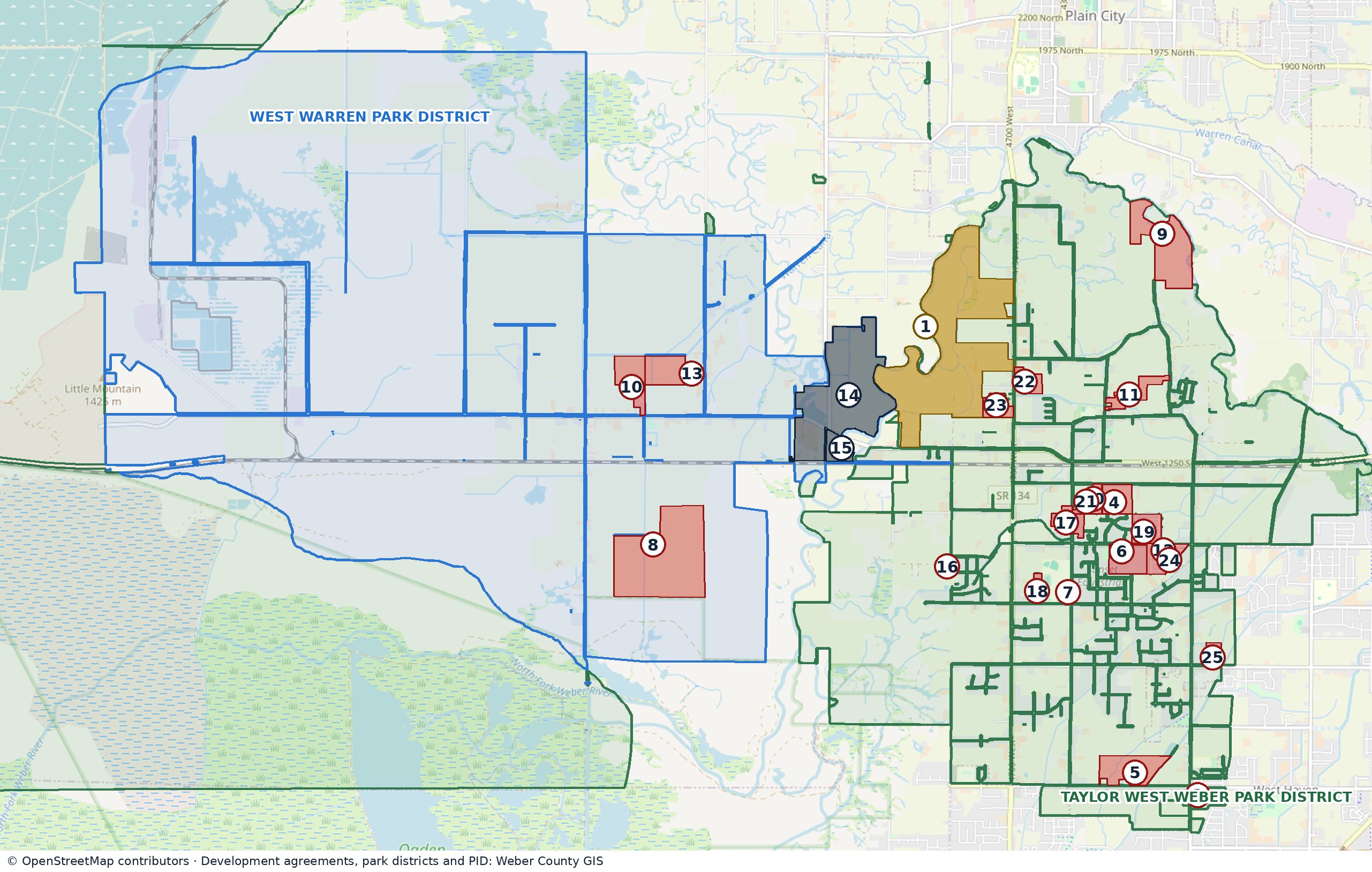
Numbered list of contracts (each opens the county's recorded contract)
- 1. Bennet Llc (county agreement no. 3400197)
- 2. Blox Development (county agreement no. 3317928)
- 3. Chad Buck Single Tree Acres (county agreement no. 3296935)
- 4. David Laloli Forge Land Co (county agreement no. 3373820)
- 5. Hamblin Investment (county agreement no. 3345141)
- 6. Heritsge Land Development (county agreement no. 3374134)
- 7. Josh Skidmore (county agreement no. 3361520)
- 8. Little Mountain Solar Llc (county agreement no. 0000001)
- 9. Lomond View Development (county agreement no. 3375299)
- 10. Longhorn Estates (county agreement no. 3328294)
- 11. Lync Holdings Llc (county agreement no. 3386391)
- 12. Ogden 3 Llc (county agreement no. 3416511)
- 13. Pat Burns Lync Construction Llc (county agreement no. 3413670)
- 14. Promontory Commerce Center (county agreement no. 3295604)
- 15. Promontory Commerce Center (county agreement no. 3311012)
- 16. Randy Ropelato (county agreement no. 3273381)
- 17. Regal Smart Fields (county agreement no. 3303020)
- 18. Single Tree Acres (county agreement no. 3408718)
- 19. Soderby (county agreement no. 3300338)
- 20. Stewart Land Holdings (county agreement no. 3277511)
- 21. Streward Land Holdings (county agreement no. 3308727)
- 22. The Holland Group (county agreement no. 3381629)
- 23. Windmill West Estates (county agreement no. 3334501)
- 24. Winston Park (county agreement no. 3347179)
- 25. Windruff Construction (county agreement no. 3437554)
Shapes: Weber County maps of builders' contracts and taxing districts, pulled Nov. 9, 2026. Base map © OpenStreetMap contributors. The port area's border isn't in the county's maps, so it isn't drawn. Some numbers overlap where contracts sit close together; the list has all of them.
Who's connected, and why
Managing Partner of BlackPine, LLC. Chair of the business park's PID board. Signs for PCC Land, LLC and GBP PCC, LLC. Listed at port board meetings on May 11, 2023, Jan. 10, 2024 and May 20, 2024.
Partner and CFO of BlackPine, LLC. Clerk of the PID board. Signed the 2026 bond notice.
Speaks for BlackPine at the planning commission, park board meetings and port board meetings.
Jim Harvey, Sharon Bolos and Gage Froerer voted on the BlackPine rezone, the PIDs, the port resolutions and the $7,500 contracts in 2023 and 2024.
Led the BlackPine tax and PID work in 2023, the port resolutions, and passing federal relief money to the PID.
Approved the West Weber area and a contract with PCC Land LLC on May 20, 2024.
Volunteer boards picked by the commission. They worked out the $7,500 and the BlackPine park land.
Chairman of the West Warren Park District board. Signed the Mar. 22, 2023 park agreement for the district. Little Mountain Service Area's March 2026 agenda lists him as that board's treasurer; its Aug. 11, 2026 agenda lists a treasurer nomination. His on-the-record points are above.
County commissioner. Moved to approve the Winston Park contract with its $7,500 park donation (Aug. 20, 2024), and on Nov. 2, 2026 said the money should also be able to pay for roads. Also sits on the Little Mountain Service Area board (March 2026 agenda), Central Weber Sewer, Weber Basin Water and, per June 24, 2025 minutes, MIDA. His 2025 and 2026 disclosure forms list Weber Basin and Central Weber Sewer but not Little Mountain or MIDA. See The Checkbox, The Trustee Signed His Own Deal and The Roybal Chain.
Lync Construction and Lync Development. The commission appointed him to the Little Mountain Service Area board on June 25, 2024 (Resolution 34-2024), the same meeting it approved passing federal relief money to the business park's sewer. He is a trustee of the Longhorn Infrastructure Financing District (2025). His Longhorn Estates contract with the county (Mar. 26, 2024) requires the $7,500-per-lot park donation. On Nov. 10, 2026, Ogden's redevelopment agency holds a work session on selling land near 1781 Gibson Ave. to Lync Development. See More Lots, Same Playbook, Then vs. Now and 1781 Gibson Ave. and Lync.
Weber County economic development director. She is also Little Mountain Service Area's manager and, since Sept. 18, 2024, a registered lobbyist for that district through her own business name, Sage Development Group. She attended the June 23, 2025 port loan committee meeting that approved the $5 million loan to PCC Land LLC, as did Daniel Stephens. See More Lots, Same Playbook and The Roybal Chain.
The water and sewer district for the West Weber corridor. Its March 2026 agenda lists Chair John Price, Manager Stephanie Russell, Treasurer Joe Giordano, and members Gage Froerer, Kami Marriott, Pat Burns, Bryan Hannah and Matthew Hatch. A builder, a commissioner and the county's economic development director all sit on or run the district that serves this growth.
KSL reported on May 20, 2024 that the family of the late Randy Marriott holds "perhaps half" of the 9,000-acre port area. Three days later, Weber Basin Water's board, with Froerer present, voted to pursue buying 25.26 acres from the Marriott family; the price wasn't made public. Kami Marriott sits on the LMSA board.
The Bennet neighborhood is "formerly Gibson Farms," per the county's May 2025 hearing notice. In January 2026, Gibson family parcels were deeded to Bennet LLC, which BlackPine manages (recorder entry 3400311). Kerry Gibson was a county commissioner from 2011 to 2018.
- Nordic Village case file (PD 200.01): on Oct. 3, 2024 the county sent the BlackPine PID board members' forms to the Nordic Village builder as "a sample disclosure statement" (GRAMA 26-1354).
- The Middlemen (PD 200.04) and One Firm, Every Hat (PD 200.05): D.A. Davidson bought the $25.9 million PID bonds; Zions Bank advised the PID.
- Three Boards, One Man, No Disclosure (PD 200.02): another Weber County PID where board members are tied to the builder. Here, the ties were written on sworn forms.
- How PIDs Work and Who Holds the Risk: what would happen if PID charges ever landed on Bennet's homes. The county's economic development director has said the county will vote in January 2027 on a PID policy that would ban PIDs with homes in them.
- Port hearing at the Legislature, Oct. 21, 2026 (Unelected Power repo): the port's director said the West Weber sewer plant "potentially" could be used by a data center, and that port tax money backs business PIDs, not housing. The port's 2025 report says the same sewer work opens "over 1000 new units of housing."
- Tooele Valley port area (Unelected Power repo): the same port loan fund lent $4.875 million there, and that area's plan names data centers as a target.
- Weber County Commission Seat A coverage, June 2026: the Jan. 8, 2026 deed (county recorder entry 3400311) moving a Gibson property to Bennet LLC, c/o BlackPine LLC.
- The Roybal Chain (Ledger LG 100.02): the campaign money and board seats around the West Weber port area, including the Little Mountain board.
- More Lots, Same Playbook (Follow the Deed): the three West Weber financing districts side by side: the business park's PID, Sage Creek and Longhorn.
- Wildcat Square (PD 200.09): another Weber County tax growth deal, to compare how much local budgets give up.
Questions readers can ask
Does this help, hurt, or neither?
- The business park's roads, water and sewer are paid back by the builder's own land through the PID, not by taxpayers in general.
- Land for parks: BlackPine agreed in March 2023 to give about 35 acres and build a park on it, with a trail, a building with restrooms, parking and a $50,000 allowance. Bennet must keep 1 acre of open space for every 34 homes, plus a park and trail along the Weber River.
- While the $7,500 went to the park districts, it let them build parks without raising taxes.
- The port sets aside some of its money for wetlands. After 25 years, all the tax goes back to local budgets.
- The park district was promised land and a park, but not the tax growth to keep it up. For 25 years, 75% of the business park's tax growth goes to the port. The county heard about this money problem in March 2023 and still moved BlackPine into the port that fall. On Nov. 2, the suggested fix was for park districts to raise taxes on residents.
- The $7,500 has no clear public rule: no county law, no public total, and different explanations in 2024 and 2026. Opening it up to roads was talked about without a public hearing.
- The builder's partners run the PID board, and that board approved the tax-sharing deals with the port. They disclosed it, but the same people are on both sides of the deal.
- Leftover federal relief money can pass through the county to that builder-run PID.
- The land went from farm zoning to up to 6 homes an acre. Froerer said on the record that buyers carry the $7,500.
- The area sits next to Great Salt Lake wetlands, and the Weber River buffer was changed in December 2024.
Meetings were announced, minutes are posted, the PID board members filed sworn forms, the PID posts its records, and the bond notice was published.
On balance it leans toward hurting on following the money. On openness it's mixed: the papers are posted, but the explanations changed.
What an auditor would still check, most important first
- 1 · Follow the $7,500How much each park district got, from which projects, whether any is held in escrow, and what it was spent on. The park districts' yearly reports on Transparent Utah and with the State Auditor should show some of this.
- 2 · The deals that pay the builder backThe Oct. 3, 2024 PID tax-sharing deals and the port's May 20, 2024 contract with PCC Land. Does the port's tax money pay BlackPine back for its own roads and sewer? The bond sale papers should explain it.
- 3 · Federal and port money for the sewerHow much federal relief money and port loan money actually went to the PID, and whether the bonds also paid for the same pump station. That takes matching the payments to the same bills.
- 4 · Bennet's future buyersIs Bennet's land headed into a PID, the port area, or both? Its contract gives up the right to protest "on behalf of… all future owners." If PID charges land on houses, buyers pay them for up to 30 years.
- 5 · The park deedWas the 35-acre park actually deeded to West Warren, and when? The county recorder would show it.
- 6 · Campaign moneyDid Stephens, Hansen, the Becks or Curriden give to Harvey, Froerer or Bolos? State campaign reports would show it.
- 7 · Where the $7,500 number was presentedThe park district's chairman says the park district and county planners each presented the $7,500 figure in public work sessions before the commission adopted it. Find those minutes (about 2019 to 2024) and the date the commission adopted the practice.
Also open: who Brad Margetts and Sam Hartman are and who owns GBP PCC, LLC; the Nov. 9, 2026 work session video on the Bennet addition and impact fees; the county's own copy of the Sept. 12, 2023 port resolution; the Aug. 12, 2025 Bennet vote count; and the county code Froerer called "ordinance." Whether requiring a "voluntary" gift before taking applications is legal is a question for lawyers or the state; this page reports what the records say.
Grade: D+ (provisional)
How the Hive grades: we ask three questions about what's good for everyone. Transparency: could the public see the decision, the papers and who was involved? Financial accountability: can the public follow where the money comes from, where it goes, and who answers for it? Environmental: what happens to the land, water and wildlife? Letter grades turn into points (A=4, B=3, C=2, D=1, F=0; a plus adds 0.3 and a minus takes away 0.3) and are averaged. This grade can change after the open items are checked.
| Test | Grade | What helped | What hurt |
|---|---|---|---|
| Transparency | D+ (1.3) | Meetings were announced, minutes are posted, and the PID board members wrote down their BlackPine ties. | On Nov. 2 staff described the money differently than the county's own 2023 and 2024 records, including saying the county "never saw the documents" after its own May 2023 minutes noted the park agreement. Nothing went to a ballot. The PID hearing lasted three minutes with no comment. The $7,500 never got a countywide rule or hearing. The PID's tax-sharing deals aren't posted, the PID's expansion map is blank, and the county's copy of the Sept. 12, 2023 port resolution isn't in its posted minutes. |
| Financial accountability | D (1.0) | The PID's bonds are paid back by the builder's land, not by taxpayers in general. | About $360.8 million of local tax growth goes to the port for 25 years, including about $206.5 million from the school district's share. $5 million in federal relief money and a $5 million port loan help pay for the builder's sewer. No public total of $7,500 money collected or where it's kept. The donated park has no money to keep it up, and the suggested fix is for residents to pay more tax. |
| Environmental | C− (1.7) | River land and park land are being saved, and the port sets aside 1% to 3% of its money for wetlands. | The area sits beside Great Salt Lake wetlands and bird areas. The river buffer was changed in 2024. The 2024 port plan favored data centers, and in 2026 water rules were loosened to follow local standards. |
| Overall | D+ | (1.3 + 1.0 + 1.7) ÷ 3 = 1.33, a D+. Can change. Grades are the Hive's judgment about what's good for the public, not a legal finding. | |
Show all sources (tap to open)
- Park Improvements Agreement for Promontory Commerce Center, West Warren Park Service Area No. 6 and Blackpine, LLC, Mar. 22, 2023 (signed and notarized; Exhibit B list of improvements; section 7 upkeep). Sent to the Hive by the park district's chairman, Nov. 10, 2026. PDF. Read from a scanned copy.
- Joe Giordano, chairman, West Warren Park District board, email to the Hive, Nov. 10, 2026, points marked for the record.
- Little Mountain Service Area board agendas, Mar. 10 and Aug. 11, 2026 (Utah Public Notice Website); Weber County Commission minutes, June 25, 2024 (Resolution 34-2024); Longhorn Estates development agreement, Mar. 26, 2024, and Longhorn Infrastructure Financing District creation records, 2025; Utah lobbyist registration, Sage Development Group, Sept. 18, 2024; UIPA loan committee minutes, June 23, 2025; Weber Basin Water Conservancy District minutes, May 23, 2024; MIDA minutes, June 24, 2025; Froerer conflict-of-interest forms, Jan. 24, 2025 and Jan. 13, 2026; KSL, May 20, 2024; Weber County hearing notice for Bennet Farms, May 2, 2025. Each is linked and quoted on the Hive pages named in "Who's connected."
- Weber County Commission work session, Nov. 2, 2026, video (item 4 starts about 32:19). YouTube. Read from the auto-generated transcript; speakers other than commissioners not named.
- Weber County Commission minutes: Dec. 5, 2023, Mar. 26, 2024, June 11, 2024 (one page footer reads "March 19, 2024"), Aug. 8, 2023, Sept. 26, 2023, June 25, 2024.
- Weber County Commission work session minutes, 2023: Mar. 6, Mar. 16, May 8, Sept. 11.
- Weber County Commission minutes, June 27, 2023 (Resolution 30-2023 hearing). min_06272023.pdf
- Weber County Commission minutes, Jan. 2, 2024 (Resolution 02-2024): min_01022024.pdf; Aug. 20, 2024, p. 2 (Winston Park agreement): Utah Public Notice Website file 1254949.
- Winston Park planning memo (July 11, 2024, p. 1) and development agreement section 9.6.1 (pp. 22, 24); "34 new lots" (p. 43) (draft in the commission packet; the signed recorded copy is linked from the map, agreement no. 3347179). Commission packet
- Western Weber Planning Commission minutes, Mar. 12, 2024. Approved minutes
- Western Weber Planning Commission minutes, Aug. 13, 2024 (Taylor Landing), pp. 2 and 6. Minutes
- Bennet master planned community staff report and proposed master development agreement ("CC Final Draft for August 12, 2025 Public Hearing"), Aug. 12, 2025 commission agenda: p. 4 (550 acres), p. 41 (3.42), p. 45 (8.2.1), p. 55 (8.9.1). Read by text extraction.
- Standard-Examiner, Dec. 10, 2024 (general plan amendment, 2-1): standard.net; Aug. 12, 2025 (TN zone and Bennet rezone): standard.net
- Black Pine rezone staff report quoting the Dec. 13, 2022 planning commission (Mar. 21, 2023 agenda).
- Utah Inland Port Authority board minutes: May 11, 2023; Nov. 6, 2023; Jan. 10, 2024; May 20, 2024. UIPA board documents
- Draft West Weber Project Area Plan, Jan. 10, 2024, Appendix D, p. 38 (read on the rendered page). Plan PDF
- Promontory Commerce Center PID board minutes, Feb. 1, 2024 and Oct. 3, 2024. 1299047, 1299049 (Utah Public Notice Website)
- PCC PID Designation Resolution, Mar. 30, 2026, pp. 3, 8 and 15 ($33,420,000; $101,426.40 an acre; PCC Land, LLC) (1412029) and Notice of Bonds to Be Issued (1412033).
- Bond sale, May 6, 2026. The Bond Buyer, negotiated sales
- PCC PID trustee disclosure forms, June 27, 2023, and county email of Oct. 3, 2024. Weber County GRAMA response 26-1354 (July 7, 2026). Forms read by OCR and checked by eye on the rendered pages.
- Taylor West Weber Park District minutes: July 10, 2025, Jan. 8, 2026, Feb. 5, 2026, Apr. 15, 2026.
- West Warren Park District: June 22, 2026 work session; 2026 meeting records.
- Utah Inland Port Authority 2025 Annual Report, p. 71 (West Weber). PDF; UIPA news, "One year in: West Weber project area" (May 20, 2025). inlandportauthority.utah.gov
- Preliminary annexation plat, Weber County Service Area No. 6 (West Warren Park), Black Pine parcels, 2023. Utah Public Notice Website file 991673
- County excavation-permit agreement for the 12th Street lift station (posted unsigned). webercountyutah.gov
- Weber County Assessor, 2026 assessed values map service, pulled Nov. 9, 2026. county map service; A-1 and A-2 lot area, Weber County Code 104-2-5.020 (Zoneomics copy)
- Utah Inland Port Authority, "UIPA Legislative Updates Following 2026 Session" (inlandportauthority.utah.gov); UIPA position on data centers, June 25, 2026 (inlandportauthority.utah.gov); UIPA board minutes June 25, 2026.
- H.B. 507 (2026), enrolled: le.utah.gov; S.B. 225 (2026), enrolled: le.utah.gov
- Weber County GIS: development agreements layer and tax entity layers (park districts, PIDs). County map service